

|
By Wire
Bringing an external partner into a conversation shouldn't mean an all-or-nothing choice between locking them out entirely or handing over full access. Wire Drive now offers a middle ground: temporary guests and outside team participants will get view-only access to shared files by default, so collaboration stays open without the risk.

|
By Wire
Shadow IT is the use of software, hardware, cloud services, or other technology for work without an organization’s IT team's knowledge or approval. It can be as simple as an employee sending a document through a personal cloud storage account or creating a WhatsApp group to coordinate with colleagues. These workarounds can help employees solve an immediate problem, but they also move company data outside the systems IT teams are responsible for securing and governing.

|
By Wire
Tag Cloud metadata fields are meant to make files easier to find, but only if the values in them stay consistent. Left open-ended, they tend to fill up with near-duplicates and typos ("Marketing," "marketing," "Mkt") that quietly undermine search and filtering. Pydio v5.1 gives administrators a way to fix that: you can now define and restrict which values are available in Tag Cloud fields, so users pick from a controlled list instead of typing free text.

|
By Wire
Open source collaboration software gives organizations more control over how teams communicate, share files, manage projects, and work together. However, the category covers a wide range of tools, and the right choice depends on what your teams need to accomplish and how much control your organization needs over its data and security. In this guide, we’ll explain the main types of open source collaboration software, the features to look for, and the best tools for different collaboration needs.

|
By Wire
As teams share more files inside Wire Drive, one question keeps coming up: how much storage are we actually using? Today, we're answering it. Wire Drive now gives team admins a clear view of storage usage right in Team Management. A simple addition with a clear goal: better visibility, without added complexity.
|
By Wire
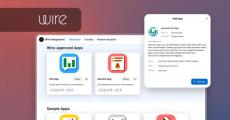
Build an app once, and share it with any other team - or, if another team has already built something you like, add it to your own team, by pasting a single App ID. No deployment, no code, no waiting. That's the headline here. As a starter kit for trying this out, Wire has built two apps of its own - Reminder and Poll - that any team can add today. They're a trusted way to see how External Apps work before building your own.

|
By Wire
On other platforms, when a group loses its last administrator because someone leaves the company or moves to another team, an authorized operator can step in. The company's IT team or the platform provider's support staff can reassign ownership, update the membership, and restore the group. Wire was designed differently. If a group lost its last administrator, no operator had the access required to repair it. The group became unmanageable.

|
By Wire
Most security teams have invested heavily in identity. Single sign-on, multifactor authentication and conditional access now guard the front door of almost every enterprise application. Access decisions keep living after that door closes, in shared folders, partner chats and guest links that nobody remembers to revoke. In our State of Secure Collaboration 2026 survey of 208 CISOs across Germany, France and the UK, 61% said access to shared files stays active longer than intended after a project ends.

|
By Wire
Few pieces of EU legislation have been declared dead as often as Chat Control, and few have returned as reliably. In July 2026 a scanning law that more MEPs voted against than for came back into force. On 29 September 2026 negotiators meet again to decide the shape of the permanent regulation. The outcome affects ministries, armed forces, defence suppliers and energy operators, because it determines how much control they keep over who can read their communications.
|
By Wire
Wire Apps SDK let developers build automations and integrations that run as full participants inside Wire’s end-to-end encrypted conversations. Until now, that meant building on our Java/Kotlin SDK. Today, we’re extending that same capability to JavaScript and TypeScript, giving teams the freedom to build in the language that fits them best.

|
By Wire
What if Europe isn’t behind in tech but simply underexposed? In this episode of Wire Uncut, we speak with Dante Emilio Grassi, founder of EU Tech Map, a platform that started as a hobby project and quickly became a movement across LinkedIn and the European tech ecosystem. In just one week, EU Tech Map grew to 1,500+ companies across 77 categories and 44 countries. But beyond the numbers, this conversation explores something bigger: visibility, digital sovereignty, and why European companies often default to non-European software.

|
By Wire
At the 2025 Labour Party Conference in Liverpool, Wire hosted a high-level panel discussion on how the UK can strengthen its digital sovereignty and resilience in an increasingly complex geopolitical landscape. Chaired by Jon Craig, Chief Political Correspondent at Sky News, the panel featured: Together, they explored how the UK can balance global collaboration with national control—aligning regulation, procurement, and innovation to build a truly sovereign digital ecosystem.

|
By Wire
In this episode of Wire Uncut, Alexandra speaks with Dan, Director of Marketing and Communication at XWiki, about the company’s journey as a European Libre Software provider. Dan shares how XWiki and CryptPad deliver secure, open source tools for collaboration and knowledge management. From powering corporate intranets and documentation hubs to enabling encrypted real-time teamwork, XWiki’s mission is to strengthen digital sovereignty in Europe.

|
By Wire
Is open source really harder to use or integrate? That perception is fading fast. Open source is now recognized for: Technical strength, transparency & interoperability Faster innovation through global collaboration A collective European alternative to Big Tech With initiatives like Eurostack, open source alliances are creating integrated, secure, and competitive solutions for Europe’s digital sovereignty.

|
By Wire
Imagine a 100% open source, secure, and privacy-first alternative to Microsoft Office 365. That’s exactly what the OpenDesk Project is building — designed for German public administration and powered by: XWiki, Nextcloud, Collabora Office, Element, OpenProject & more Decentralized, secure, and transparent solutions Partnerships across Europe to strengthen digital sovereignty This is Europe’s collective answer to Big Tech — and it’s already happening.

|
By Wire
Switching from legacy systems or Big Tech doesn’t have to be risky. In this clip from Wire Uncut, Bozhena, VP of Marketing at Meister, explains why the hardest challenge in public sector digitalization isn’t the technology, it’s change management.#podcastclips.

|
By Wire
n this Wire Uncut conversation, Meister shares how they build collaborative productivity tools designed to make teamwork intuitive, effective, and secure. #wire.

|
By Wire
Can Europe build productivity tools that rival Big Tech—without sacrificing security or usability? In this episode of Wire Uncut, we sit down with Bozhena, VP of Marketing at Meister, the company behind MeisterTask and MindMeister. From helping teams transition from pen-and-paper workflows to becoming the trusted partner for digitalization in Germany’s public sector, Meister is redefining collaboration in Europe.

|
By Wire
Why is it so hard to leave Big Tech? In this short clip, Andy Piper from Mastodon shares a powerful reflection on human behavior and why the comfort of the familiar often keeps us from discovering better alternatives. "We forget that the tools we’re comfortable with now once felt unfamiliar too. Growth means discomfort first." Try something new. Change how you connect. From our full Wire Uncut conversation on Mastodon, digital sovereignty, and ethical tech.

|
By Wire
"We're not here to sell your data. We're here to empower you." In this quick clip from Wire Uncut, Andy Piper, Head of Communications at Mastodon, shares the platform’s bold mission: to build an open, user-first, ad-free social experience - and why that matters more than ever today. Discover what makes Mastodon more than just a social network, it’s a movement.
- October 2026 (3)
- September 2026 (10)
- August 2026 (12)
- July 2026 (5)
- June 2026 (4)
- May 2026 (4)
- April 2026 (2)
- March 2026 (5)
- February 2026 (2)
- January 2026 (5)
- December 2025 (6)
- November 2025 (6)
- October 2025 (10)
- September 2025 (7)
- August 2025 (16)
- July 2025 (15)
- June 2025 (15)
- May 2025 (8)
- April 2025 (12)
- March 2025 (11)
- February 2025 (4)
- January 2025 (8)
- December 2024 (3)
- November 2024 (3)
- October 2024 (4)
- September 2024 (1)
- August 2024 (1)
- June 2024 (2)
- April 2024 (2)
- March 2024 (2)
- February 2024 (2)
- December 2023 (3)
- August 2023 (2)
- July 2023 (2)
- May 2023 (1)
- March 2023 (1)
- August 2022 (1)
- June 2022 (2)
- October 2021 (1)
- September 2021 (3)
- August 2021 (1)
- July 2021 (1)
- June 2021 (3)
- May 2021 (2)
- April 2021 (4)
- March 2021 (3)
- February 2021 (3)
- January 2021 (3)
- December 2020 (5)
- November 2020 (4)
- October 2020 (2)
- September 2020 (2)
- August 2020 (2)
- July 2020 (1)
- June 2020 (4)
- May 2020 (4)
- April 2020 (3)
- March 2020 (1)
- February 2020 (2)
- January 2020 (2)
- December 2019 (4)
- November 2019 (4)
- October 2019 (5)
- September 2019 (4)
- August 2019 (2)
- July 2019 (6)
- June 2019 (2)
- May 2019 (7)
- April 2019 (1)
- March 2019 (4)
- February 2019 (3)
- January 2019 (1)
- December 2018 (5)
- November 2018 (3)
- October 2018 (3)
- September 2018 (6)
- August 2018 (5)
- July 2018 (6)
- February 2018 (5)
- April 2017 (1)
- November 2016 (1)
Wire is the most secure collaboration platform. Secure messaging, file sharing, voice calls and video conferences. All protected with end-to-end encryption.
Chats, voice and video conference calls, and shared documents are all protected with end-to-end encryption so only the sender and receiver can access them. Crystal clear calls, rich feature set and ease-of-use help people and teams work together faster and with confidence that their data is protected by European privacy laws. Wire does not hold the decryption keys for your communication.
Why Wire?
- Three-in-one: No more hopping between file sharing, conferencing, and messaging apps. Wire keeps everything safe in one place, making it easier to control and audit your data, and stay compliant with regulations such as GDPR.
- Simply secure: People like workplace tools that are easy to learn and simple to use. IT teams want guaranteed security, robust administration tools, and full control. Wire offers a perfect blend between ease of use, control, and security.
- Ready for business: Wire is built to scale to tens of millions of users, and with the right administrative tools. Ready for ISO, GDPR, and SOX. 100% open source, and independently audited — with an option to be tested against your existing security and governance frameworks.
Wire is available on all major platforms, keeps conversations nicely in sync across multiple devices and doesn’t require a phone number to register.