We’ve seen a serious uptick in misinformation about Element and Matrix over the last week, so thought it would be useful to set the record straight from Element’s side.
Element will participate in the Building Sovereign Digital Workspace discussion track at UN Open Source Week. We’ve been invited to present a session titled: “The importance of open standard federation for chat.” A genuine open standard is the single most important part of ensuring digitally sovereign communications between multiple separate organisations.
Germany’s public healthcare insurers will go live with real time communications based on the TI-Messenger standard on 15 July. With that being just six weeks after TI-Summit, a conference all about the telematics infrastructure for Germany’s healthcare industry, it’s fair to say that TI-Messenger is the most popular chat at TI-Summit!
End-to-end encryption (E2EE) is a foundational feature for secure digital communication, ensuring that servers can never see your conversation data - even if breached or legally forced. Unfortunately, it’s a term that has been repeatedly distorted - Microsoft Teams claims to be end-to-end encrypted when in practice support is partial at best. As more enterprise tools add E2EE to their feature list, it's important to unpack what that claim actually entails — and what it doesn't.
On Monday, Matrix.org (a free Matrix public server) started running Matrix Authentication Service (MAS), the next generation authentication system based on OAuth 2.0/OpenID Connect. This is a major leap forward for Element as it means that Element X users on Matrix.org can now finally benefit from all the security and usability benefits of next gen auth, paving the way for QR-code login, 2FA, MFA and more!
A major milestone for Matrix in German healthcare. We are thrilled to launch our first TI-Messenger compliant edition of Element Server Suite built specifically to suit gematik’s TI-Messenger solution for German healthcare. This edition marks a significant milestone in our advancements in compliance, scalability and usability for nation-scale Matrix deployments.
A key component of Element X, Element Web and Element Desktop is the voice and video capabilities made possible by Element Call using the MatrixRTC backend (including LiveKit). Element Call powers end-to-end encrypted (E2EE) in-app voice and video calling at scale for our flagship messaging apps. It delivers high fidelity video calls, emoji reactions, flawless conference calls and screensharing. Of course, it also works over federation.
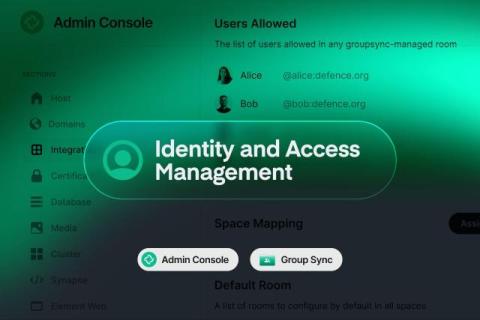
In the wake of Signalgate, we’ve had many people ask us how an enterprise-grade deployment of Element ensures that only the right people are in the right conversations. It’s an interesting insight into just how pervasive the use of consumer messaging apps within governments (and workplaces) has become. Based on their experience of WhatsApp or Signal, people simply don’t expect a messaging app to have enterprise-grade guardrails.
The Trump administration’s spectacular security breach, in which it seemingly shared details of a planned military strike in Yemen with a journalist, highlights just what can go wrong if you use consumer messaging apps to run your government. It’s beyond all reasonable logic that any government would use a consumer messaging app for even the most mundane chat. That it’s commonly used by the highest echelons of government on the most sensitive of topics is simply mind-boggling.
The recent incident involving the inadvertent inclusion of a journalist into a Signal group chat where US officials discussed sensitive military operations highlights the complexities governments face when using consumer messaging applications for official communications. Historically, various government administrations have used commercial messaging apps for official purposes. For example, Boris Johnson’s administration, and Macron’s team before France chose to standardise on Element.