
Teams | Collaboration | Customer Service | Project Management

Automated time tracking: how it works and why your team needs it

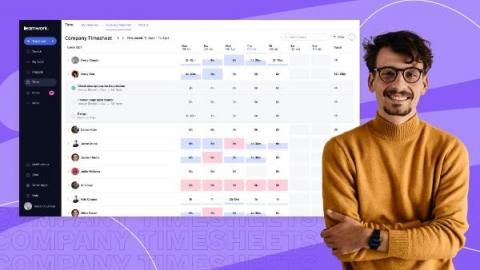
Every professional services team I've been part of has had the same argument at some point: "Why aren't timesheets getting done?" Before I joined Teamwork.com, I spent years managing delivery for agency teams. The answer was always the same. Manual time tracking is painful, so people avoid it. Automated time tracking fixes the root cause by removing the manual work entirely. This guide breaks down how it works, what methods are available, and how to choose an approach that actually sticks with your team.

Resource levelling: what it is, how it works, and when to use it

I spent the best part of a decade in client services, and have seen firsthand how resource planning can make or break your team and projects. If there is one thing I have learned, it is that most project delays do not start with bad estimates or unclear scope. They start with a resource plan that looks fine on paper but falls apart the moment two projects need the same person on the same day.

Benchmarking for projects: how to measure what matters and close the gap

A project that finishes on time isn't automatically a project that performed well. I've seen plenty of "green status" projects that quietly burned through margin, overloaded the team, and left the client underwhelmed. Without a reference point, you can't tell the difference between a genuinely healthy project and one that just crossed the finish line.

How to handle scope creep before it wrecks your margins

Scope creep doesn't announce itself. It shows up as "a small tweak" here and "one more round of revisions" there. By the time you notice, the project that was supposed to be profitable is bleeding money. I've spent years managing projects inside professional services firms and now at Teamwork.com. The pattern is always the same: small, untracked additions that seem harmless but collectively eat the entire margin.

The future of agency operations isn't about AI. It's about control.

I spent a day in New York with agency leaders, operators, and industry experts at OPERATE'26, Teamwork.com's inaugural Agency Leaders Summit. The conversations covered scaling, profitability, AI, talent, and leadership. But the strongest takeaway wasn't fear about the future. It was optimism. Here's what the day kept coming back to.

What c-suite leaders miss when agencies scale

Growth looks exciting from the boardroom. More customers. More revenue. More headcount. More opportunity. But for the people responsible for turning strategy into reality, growth feels very different. It feels like communication breaking down. Managers becoming stretched. Processes that once worked suddenly collapsing under the weight of scale. Customers experiencing the impact before leadership dashboards ever reveal a problem.

A streamlined Task Details experience, shaped by your feedback

We're always looking for ways to make the work you do in Teamwork.com feel simpler. Over the past year, one theme that has consistently appeared in customer conversations, product research, and your direct feedback? Task Details—one of the most heavily used areas of Teamwork.com—can sometimes feel busy, overwhelming, and maybe even a little cluttered at times.

Assign Tasks to Roles: Plan before assignment is finalized

Project planning rarely starts with task assignment locked in. You know the work that needs to happen, but the exact people? That often comes later. Until now, tasks in Teamwork.com required you to assign work to a specific user or team from the start. That created friction during early-stage planning, especially when task assignment decisions were still evolving.

How to forecast delivery capacity from your sales pipeline

The core question every professional services operations leader needs to answer: can your team actually deliver the work that is likely to close? Generating pipeline is only half the challenge. The other half — the one that quietly breaks delivery teams — is knowing whether you have the capacity to absorb that work before contracts are signed and start dates are set.