
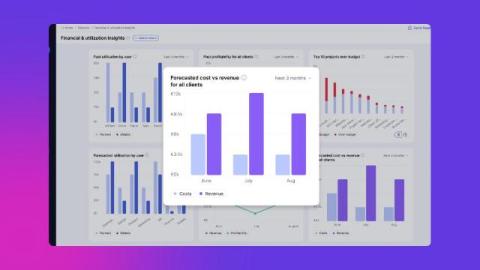
Teams | Collaboration | Customer Service | Project Management

The business case for switching to a PSA: a five-step payback test

The business case for switching to a PSA comes down to three of your own numbers: what staying costs, what switching costs and how fast it pays back. Approve the switch if it still pays back in under 12 months when adoption goes half as well as planned, and pilot first if it doesn't. I work at Teamwork.com now, but in my agency roles clients asked for more inside the same retainer, and nobody priced it, so staying always looked free.

PSA security and compliance: what finance leaders should check before signing

PSA security and compliance means checking two things: that a vendor's controls are independently proven, and that your permissions keep margin data with the right people. PSA here means a professional services automation platform, which connects projects, resources and financials, not the IoT security scheme that shares the acronym. At Teamwork.com I brief agencies and research partners from the client side, and I'll take one dated, readable report over a wall of badges.

Skills in Ask AI: less prompting, more time to deliver

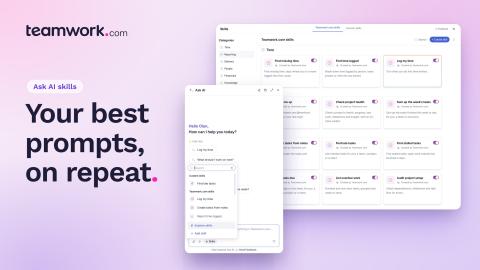
Skills are coming to Ask AI: saved requests you run with a single command. Type /, pick a skill, and get the status update, late-work list or timesheet check your team needs every week. No more retyping last week's prompt and tweaking it until the output looks right. Your team gets reliable answers in one step and spends its time on client delivery, not on describing it.

Why agencies are fully booked but not profitable, and how to find your cause

The main reason why agencies are fully booked but not profitable is that the calendar counts hours worked, not hours billed at the rate you sold. Looking back from Teamwork.com, over-servicing was the biggest drain of my agency years: clients asked for more inside the same retainer, and nothing recovered the cost. A full team that still can't show a profit is exhausting, and it rarely means people are slacking or clients are wrong.

AI in professional services statistics (2026): 30+ data points from SPI Research

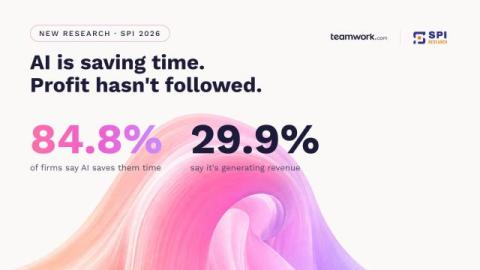
AI is used on 43.6% of professional services projects in 2026, nearly double the 23.1% in 2025, according to SPI Research's 2026 Impact of AI on Professional Services study of 245 firms. But the payoff is uneven: 84.8% of firms say AI saves them time, while only 29.9% say it generates revenue. The study covers management and IT consultancies, professional services teams inside software and SaaS companies, and other professional services firms across the Americas, EMEA and APac.

AI in professional services is leaking margin. Here's how to plug it.

Every services firm I talk to is measured on three things: delivering on time, keeping billable utilization healthy, and delivering projects profitably without over-servicing. AI should help with all three. So far, it's helping firms deliver faster. It isn't yet making them more profitable. SPI Research's 2026 Impact of AI on Professional Services study shows the gap. AI now touches 43.6% of projects, nearly double a year ago, and firms using it on most of their projects deliver far more of them on time.

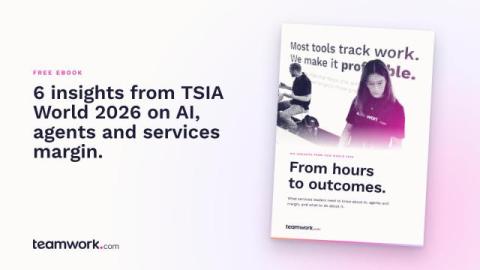
From hours to outcomes: 6 insights from TSIA World 2026

AI budgets have moved to the CEO and CFO, and they want proof. That was the clearest message at TSIA World 2026 in Las Vegas. "These budgets are at the C-suite. This is your customer now. The CEO, the CFO... they want to see the results." Thomas Lah, Executive Director, TSIA Most services firms aren't ready to give them that proof. TSIA's survey of its advisory board found: We spent three days in sessions, on the floor and at our booth.

9 best project profitability software tools for 2026

Before I joined Teamwork.com, I spent years inside professional services firms watching the same pattern play out. A project would close, the team would celebrate, and then finance would run the numbers and discover we barely broke even. The margin had eroded slowly across dozens of small scope additions that nobody tracked individually but that collectively ate the entire profit.

What does agentic PSA mean? A plain guide to what the agents actually do

Agentic PSA is professional services automation where AI agents do parts of the operational work, such as drafting a client update, and a person approves the result. A PSA, or professional services automation platform, connects projects, resources and financials in one system, and the "agentic" part is about who does the work inside it. At Teamwork.com, I run AI on my own project admin, status updates and reporting, and nothing goes out until a person has checked it. That check is why I trust the output.

Professional services billing: how to pick the model that protects your margin

Your billing model decides who pays when an estimate turns out wrong, so choose it per engagement rather than by habit. Professional services billing is how a professional services firm turns delivered hours, phases or ongoing access into invoices a client agrees to pay. Before I joined Teamwork.com, I managed agency accounts where underbidding at the pitch caused most of the scope disputes that followed. That's why this guide treats the model as a risk decision.