
Teams | Collaboration | Customer Service | Project Management

Employee Advocacy Statistics: What the Latest Research Means for Your Team

Your marketing team shares a company update internally. The message is ready, the link works, and employees are encouraged to post it. Then very little happens. It is easy to assume people are uninterested. But perhaps the request arrived during a busy workday, without explaining why the news matters or what employees could add to it. Some may be unsure what they are allowed to say. Others may like their employer but prefer to keep company promotion off their personal profiles.


Say yes to AI context without losing control: a new way to set up and govern connectors in Atlassian Administration

Maya runs IT for Beaconstone Financial, a fintech company with 2,000 employees. Her engineering teams work in Jira and GitHub. Sales lives in Salesforce. Most decisions happen in Slack threads, Google Docs, and SharePoint folders that nobody can find six months later. Leadership wants Rovo to answer questions across all of it. Her head of sales has asked for account briefs that pull in the latest Salesforce opportunity data and last week’s customer call.

Architecture Project Management Software: A Practical Comparison of 6 Tools

Architecture firms often start with a basic project tool and spreadsheets. But as projects and teams grow, this setup becomes harder to manage. Budgets, timesheets, schedules, and invoices may be spread across different tools. This makes it harder to track project performance without manually checking and matching the data. For a principal, the cost often becomes clear too late. A design stage may exceed its budget, but you only find out when the project closes.

AI Resource Management for Operations Leaders

Resource management is mostly admin. Checking who’s overbooked, finding cover when someone’s off, or moving every date when a client slips. AI can now take on a lot of that work, from answering questions about your schedule to actually making the changes. This guide covers what AI in resource management usually handles today, and the data it needs before you can trust it to reschedule your people.

Outgrown Trello? 8 alternatives that retire the spreadsheet beside your board

For most of my nine years in agencies, moving tasks along was the easy part. The hard part lived in spreadsheets: who was free next week, which hours never got logged, and whether a retainer still paid its way. I had a basic timer and a lot of tabs, and the tabs were always a few days behind. I work at Teamwork.com now, and I see the same thing in teams shopping for Trello alternatives. Trello is still a strong board, and Premium adds Timeline, Table, Calendar, Dashboard, and Map views.

11 ClickUp alternatives, sorted by what you'd still have to build

ClickUp can be configured to do almost anything, and for a services team that's the catch. It tracks tasks, not money, so rate fields, budget formulas and utilization views all have to be built and maintained by someone on your team. If you're comparing ClickUp alternatives, that build cost is the number to measure first. I work at Teamwork.com. Before that, I spent nine years in agencies, where the numbers I trusted least were always the ones that depended on someone remembering to fill in a field.

DPDP Act Compliance Checklist Every CIO And CISO Must Complete Before An Audit

Most Indian enterprises have read the DPDP Act by now. Far fewer have tested whether their security stack can prove what it asks for. That gap matters more than awareness. When the Data Protection Board, a customer’s due diligence team or an internal auditor asks how personal data on employee endpoints is protected, a policy document will not settle the question. Controls, logs and evidence will.

Every shift, every site, every team: Introducing Slack Frontline

To your customers, your frontline workers are your brand: the shop assistant who finds the right size, the warehouse lead who ships the order, the home nurse who checks in. They make up about 80% of the global workforce, yet they’ve been left out of the last decade of workplace transformation. While corporate teams have agents, instant customer data and connected systems, the frontline often runs on paper checklists and group texts, without even a corporate email address.

Employee Monitoring Laws

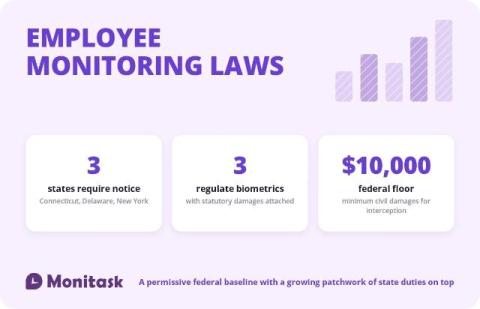
Employee monitoring is lawful across the United States. That is the correct starting point and it is where most guides stop, which is why employers get caught out by the second half. Federal law permits an employer to monitor its own systems for a legitimate business reason. Four states add a duty to give prior written notice, three regulate biometric identifiers, and a separate set of rules governs audio recording, video, GPS and how monitoring data is later used.