
Teams | Collaboration | Customer Service | Project Management

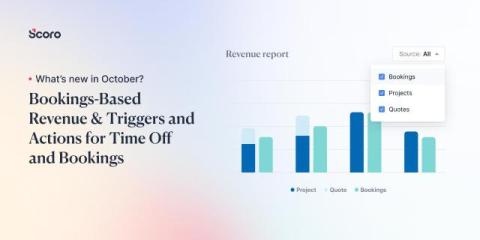
What's New in October 2026: Bookings-Based Revenue & Triggers and Actions for Time Off and Bookings

Is it already the end of October? Wow. Time truly flies when our team is busy working on updates. This month, there are tons of useful improvements for everyone! You can now see what your resource bookings are worth with the new bookings-based revenue, and set up automated rules about time off and bookings. And that’s not all – from task dependencies in the project task list to subtasks in task bundles, there’s plenty more below.
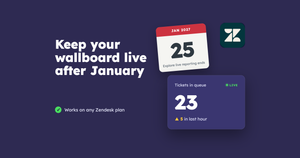

Zendesk Explore live dashboards are retiring: what to do before 25 January 2027

Zendesk is retiring Explore live reporting on 25 January 2027. Prebuilt live dashboards will be removed, and live components in custom dashboards will stop displaying data. If your team relies on an Explore wallboard, now is the time to plan its replacement. Zendesk’s replacement is real-time monitoring, available to Professional and Enterprise customers. Geckoboard gives you another route: custom live dashboards on TVs, alongside your other tools, without changing your Zendesk plan.

Communications Compliance in Finance: 6 AI Lessons

Running communications surveillance at a financial organization today often means being under increasing pressure to bring AI into daily workflows. For many organizations, this raises the question of how to have AI screen alerts and shape decisions in a way that is in accordance with regulatory requirements.

Best AI Assistants for Professional Business Emails: Six Tools Worth a Look

At 4:45 p.m. a customer asks if Friday’s delivery is confirmed. Operations have a date. Sales promised an update. The account manager is about to join another call. An AI email assistant can produce an answer in seconds.. The wrong answer might cost the team an entire afternoon. Business email needs more than sentences. The useful tools solve problems. Some retrieve the context of a thread. Some improve phrasing. Others stop colleagues from answering the same request twice.

How to Track Project Progress: Methods That Give You a Real Number

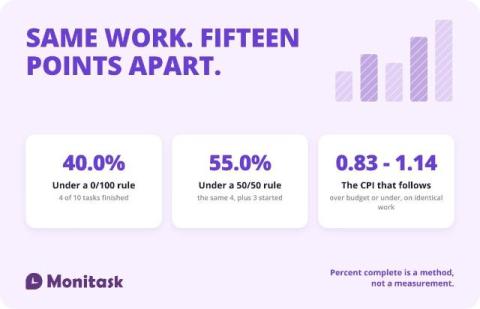
Tracking project progress means producing one defensible number: the percentage of planned work actually finished. That number depends on the method used to credit partially finished work, and the choice changes the answer. A project with four of ten tasks done reads 40% under a 0/100 rule and 55% under a 50/50 rule — the same work, fifteen points apart.

Project Management Dashboard: Metrics, Formulas and How to Build One

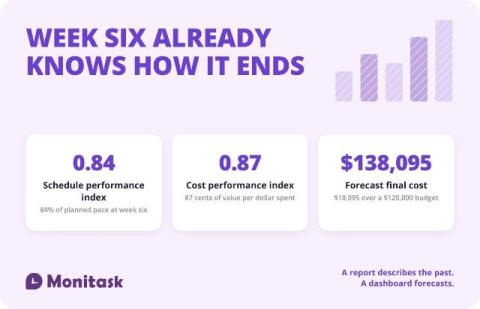
A project management dashboard shows the few numbers that tell you whether a project will finish on time and on budget. The core set is schedule variance, cost variance, the schedule and cost performance indexes, and a forecast of final cost. All four come from three inputs: the budget, the percentage of work actually complete, and the cost incurred to date.

AI workslop is a standards problem

AI makes it possible to produce work quickly, but it can also result in a lot of workslop—that is, work that looks polished, but does little to move the project forward. Sorting through workslop is time-consuming and undercuts the ROI on AI. It may look like productivity, but it just moves the actual work farther downstream. The Teamwork Lab realized that workslop isn’t an AI problem, or even a people problem.

Aligning, deciding, and building toward better outcomes

If agents write the evals, draft the specs, and run the loops, what work is left for a product manager? One answer I keep seeing online is that product writes the evals, approves the agents, orchestrates the loops, and picks one at the end. At ProductCon San Francisco, I made the case that product’s role is much bigger: deciding what’s worth building and bringing a team along, which is especially important as agents accelerate building.