

Teams | Collaboration | Customer Service | Project Management

How to Connect Time Tracking to Payroll without Manual Reconciliation

Every payroll cycle, HR and operations teams lose time chasing missing hours, checking PTO, reviewing overtime, and manually reconciling data across spreadsheets and tools. The root cause is usually the same: time data is collected for one purpose but needed for another.


Employee Satisfaction Statistics 2026: What the Numbers Tell Us (And What They Can't)

Just imagine. You can work from anywhere. Your employer trusts you to manage your schedule. Meetings are productive instead of exhausting. At the end of the day, you close your laptop feeling fulfilled rather than drained. Your manager supports your growth. Your personal goals align with your professional path. The career ladder feels stable enough that you don’t constantly worry about what comes next.

How to Improve Work Performance

If you’re searching for how to improve work performance, most advice repeats the same tips like goal setting and reducing distractions. But it rarely tells you whether anything actually improved. Work performance does not improve from advice alone, it improves when output is defined clearly and tracked over time so progress becomes visible.

7 Productivity Management Techniques That Work in 2026

Productivity management techniques are structured approaches managers use to improve how a team turns time and effort into actual output. Not morale. Not activity. Output. Most teams struggle with productivity not because people are not working hard but because there is no system for deciding what work to protect, what to remove, and how to tell the difference. These productivity management techniques fix that gap.

How the revenue team at Asana saved $100k a year by automating workflows

When Steven Borobio-Bennett, APJ Programs and Operations Leads at Asana, starts his day, his Slack inbox is already full. Reps and partners from across the region come to him when something needs attention—a deal question, an escalation, a process issue that needs a fast answer. The messages never stop. Steven is the expert they need, but he’s only one person. And when response time slowed down to days, deals slowed down with them.

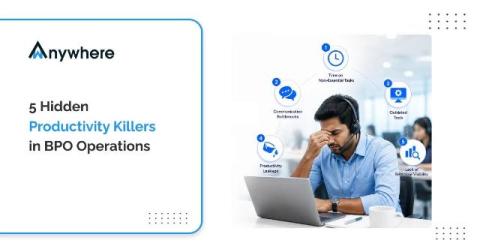
5 Hidden Productivity Killers in BPO Operations (And How to Fix Them)

Your agents are logged in. Your dashboards are green. Your reports say utilisation is at 82%. Yet SLAs are slipping, CSAT scores are dipping, and your best team leads cannot explain where the hours are going. This is the central paradox of BPO productivity: the losses that hurt you most are the ones that never show up in your standard reports.

What Is Time Theft at the Workplace and How Do You Prevent It?

‍ "Time theft" is one of those phrases that sounds more sinister than the reality usually is. Most of it isn't employees scheming to defraud the company — it's buddy punching, long unlogged breaks, or hours quietly lost to distraction. But it's real, it adds up, and across a whole team it can quietly drain serious money and fairness from a business.

How to Calculate Project Profitability for Agencies: A Practical Guide

Project profitability is the profit a project generates after subtracting all costs required to deliver it: labor, contractors, expenses, and overhead. The core formula is project profit equals project revenue minus total project costs. This guide walks agencies through a repeatable method to calculate project margins, identify where costs accumulate, and track profitability in time to act on it, whether you use a spreadsheet, a finance system, or time tracking software.

Kanban vs Scrum: Which Agile Framework Is Right for Your Team?

Kanban and Scrum are both agile frameworks used to manage work, but they solve different problems: Kanban is a continuous-flow system built around visual boards and work-in-progress limits, while Scrum is a structured, sprint-based framework with fixed roles, ceremonies, and time-boxed iterations, and the right choice depends on whether your team's work arrives unpredictably or can be planned in advance.