
Teams | Collaboration | Customer Service | Project Management

The leadership advantage AI can't automate: Attention

As AI accelerates work, leaders need to be more deliberate about what technology takes off people’s minds and where human attention can create the most value. AI promises to help organisations move faster. But at two Asana executive dinners held in Sydney and Melbourne in August, a different leadership question emerged: what should we choose not to accelerate? The challenge is not finding more hours in the day, but creating better conditions for the hours people already spend.

We're bringing governed agent loops to the AI-Native SDLC

Here’s a stat that’s been rattling around in my head. In our 2026 AI SDLC study, 94% of engineering leaders told us they’re using AI, but only 6% have the systems to actually scale it across their whole software lifecycle. Almost everyone is playing with agents, yet almost no one can let agents run at scale without things breaking.

What AI work management actually means for client delivery teams

Most vendors sell "AI work management" as a prettier board with a chat box. That framing is too small for anyone running paid client delivery. AI work management is the operating layer that decides who does what, when you can safely promise dates, and what the work actually costs. It also decides which parts a supervised AI agent can take without wrecking trust. Before I joined Teamwork.com, I saw the spreadsheet version of that job repeatedly across agency environments.

AI financial insights for professional services leaders

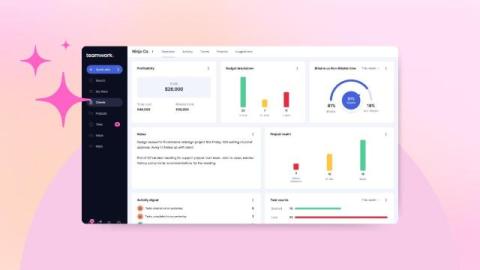
AI financial insights for professional services leaders are not a chatbot bolted onto last month's export. At Teamwork.com, we see leaders need margin, utilisation, and forecast signals while work is still movable. For example, a delivery lead can change staffing mid-project before an overrun hits the P&L; I've watched firms mistake a prettier dashboard for insight.

AI made you faster. It didn't make you better.

One point four million real workplace conversations with AI were analysed last year. About 5% of people were using it in ways that improved the quality of their work. The “Are you using AI?” conversation is over. Nobody won it. We just stopped having it. But the question we skipped is, “Is anyone reading this stuff before it gets sent?” Increasingly the answer is no, and we can all tell.

What should we choose to keep human in the age of AI?

I’m TJ Power, a neuroscientist, no.1 bestselling author of The DOSE Effect, and the founder of DOSE Lab. Over the last 12 months, my team and I have been laser focused on a new question: how can we help society build successful brains that are ready for the AI future? Recently, with Asana, I hosted a series of dinners in Sydney and Melbourne for C-suite executives.

AI Agent for Employee Queries: How HR Teams Automate the Top 10 Requests

“How much PTO do I have left?” “Where can I find my latest payslip?” “Am I eligible for this benefit?” These are simple employee questions, but resolving them can mean checking the HRIS, searching policies, retrieving live data, chasing approvals, and updating records. At scale, that administrative work adds up.